The most valuable bathroom improvements are not always the ones that dominate a reveal photo. A beautiful vanity or dramatic tile wall changes how the room looks, but water-efficient fixtures, better hot-water delivery, and early leak detection can change what the room costs to operate and maintain.
7 overlooked bathroom upgrades that save water and money focuses on decisions that are easiest to make while walls, plumbing, and fixtures are already being updated. The goal is not to turn a luxury bathroom into a utility room. It is to make comfort, performance, conservation, and long-term protection part of the same design.
Savings vary with household size, existing fixtures, local water and energy rates, and daily habits. The best approach is to compare the current bathroom with the proposed products and prioritize upgrades that solve a real source of waste.
Why Small Bathroom Details Have a Large Financial Effect
The logic behind bathroom upgrades is cumulative. A few gallons saved each day, shorter waits for hot water, and one leak found early can matter more over time than a decorative feature that is rarely used.
Bathrooms combine pressurized water, drainage, electricity, heat, and moisture in a small footprint. That makes product compatibility and installation quality especially important. A high-efficiency fixture should perform well at the home’s actual pressure. A leak sensor should sit where water is likely to appear. A recirculation system should be controlled so it does not waste energy continuously.
Think in three categories. First, reduce the water used during normal routines. Second, reduce the energy needed to heat and deliver that water. Third, identify failures early enough to prevent damage to cabinetry, drywall, flooring, and rooms below.
Bathroom Upgrade Comparison at a Glance
The table below compares each improvement by its primary benefit and the most important planning check.
| Upgrade | Main Saving or Protection | Key Planning Check |
| WaterSense toilet | Reduces water used with every flush | Verify rough-in, flange, supply valve, and service access |
| Efficient showerhead and controls | Cuts water use and water-heating demand | Check pressure, combined outlet flow, and valve compatibility |
| Faucet or certified aerator | Reduces everyday sink flow at low cost | Match threads, reach, spray pattern, and sink depth |
| Demand-controlled recirculation | Reduces water wasted while waiting for heat | Measure pipe run and select appropriate controls |
| Hot-water pipe insulation | Limits heat loss through accessible piping | Coordinate insulation with supports, access, and firestopping |
| Leak detection | Identifies irregular use before damage spreads | Plan sensor placement, power, alerts, and shutoff behavior |
| Pressure correction and shutoffs | Controls excess flow and improves emergency access | Test pressure and install serviceable valves |
1. Choose a WaterSense-Labeled Toilet That Performs Well
The first of 7 Overlooked Bathroom Upgrades That Save Water and Money is a toilet selected for both efficiency and real-world performance. The label matters, but bowl height, rough-in dimension, flush design, supply condition, and serviceability matter too.
Compare the Existing Toilet Before Estimating Savings
Older toilets may use substantially more water per flush than current efficient models. A WaterSense-labeled toilet uses 1.28 gallons per flush or less and must meet performance requirements. The EPA reports that replacing old, inefficient toilets can reduce the average family’s toilet water use by 20 to 60 percent, depending on what is being replaced.
Check the model number or tank label of the existing fixture when possible. Savings from replacing a relatively recent 1.6-gallon toilet will be smaller than savings from replacing a much older high-volume fixture. This prevents inflated payback claims and gives the homeowner a more honest comparison.
Inspect the Flange, Shutoff, and Supply Connection During Replacement
A new toilet is an opportunity to inspect the mounting flange, wax or elastomeric seal, water supply, and shutoff valve. A corroded stop or damaged flange can undermine an otherwise premium installation.
Choose a toilet whose trapway, flush components, and replacement parts can be serviced without disturbing nearby finishes. In a luxury room, concealed or wall-mounted designs may create a cleaner appearance, but they need proper in-wall support and a practical access strategy.
2. Pair an Efficient Showerhead With the Right Valve
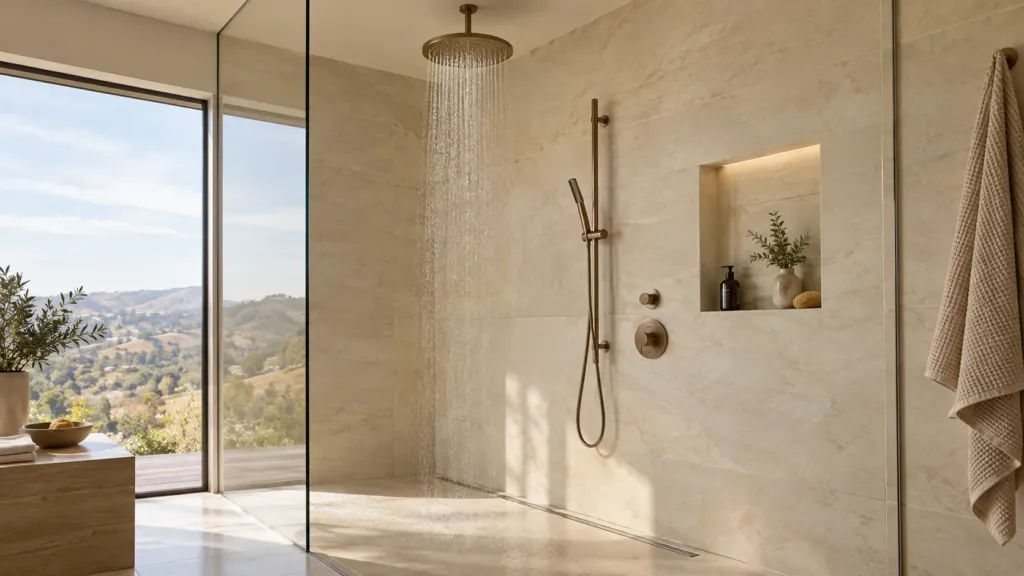
A water-efficient showerhead improves one of the bathroom’s longest water-consuming routines. The right model reduces flow without making the shower feel weak.
Look Beyond the “Low-Flow” Label
WaterSense-labeled showerheads use no more than 2.0 gallons per minute and are independently certified for water efficiency and performance. According to the EPA’s WaterSense showerhead guidance, the average family could save 2,700 gallons of water and more than 330 kilowatt-hours of electricity each year by installing labeled showerheads.
Performance still depends on the home. Check available pressure, the number of shower outlets, and whether the design includes a rain head, handheld spray, or body sprays. Running several outlets together can erase the savings expected from one efficient fixture.
Specify Pressure Balance, Temperature Control, and Volume Control Deliberately
A pressure-balancing or thermostatic valve improves temperature stability, while a separate volume control lets the user reduce flow without changing the chosen temperature. These features can make an efficient shower feel more controlled and luxurious.
Confirm that the trim and rough valve are compatible before walls close. If a homeowner wants multiple shower functions, a designer or plumber should map which outlets can operate simultaneously and calculate the combined flow rather than evaluating each component alone.
3. Upgrade the Faucet or Install a Certified Aerator
A faucet aerator is often the least expensive improvement in the room. It can reduce sink flow while maintaining a useful stream for handwashing, shaving, and brushing teeth.
Match the Flow Rate to the Way the Sink Is Used
WaterSense-labeled bathroom faucets and accessories use no more than 1.5 gallons per minute. The EPA’s bathroom faucet guidance states that replacing inefficient faucets and aerators can save the average family about 700 gallons of water per year.
An aerator is not automatically compatible with every faucet. Confirm the thread type, finish, manufacturer requirements, and desired spray pattern. For a vessel sink, also consider splash. Excessive flow or a poorly aimed stream can send water beyond the basin and damage surrounding cabinetry.
Use the Faucet Replacement to Address Drips and Access
A faucet that looks dated may also have worn seals, stiff controls, or difficult-to-reach supply connections. During replacement, inspect the shutoff valves, flexible supplies, drain assembly, and countertop penetration.
Choose components with accessible cartridges and available replacement parts. A premium finish delivers better long-term value when routine repairs can be completed without removing the countertop, mirror, or vanity.
4. Add Demand-Controlled Hot-Water Recirculation
Demand-controlled hot-water recirculation addresses the clean water that goes down the drain while someone waits for the shower or faucet to become warm. It is most relevant when the bathroom is far from the water heater.
Measure the Wait Instead of Assuming the Problem
Time how long hot water takes to reach the farthest fixture and estimate the flow during that wait. A long or oversized pipe run can hold a surprising amount of cooled water. In some homes, a better plumbing layout during remodeling can shorten the run without adding a pump.
When rerouting is not practical, a recirculation system may improve convenience. Demand-controlled systems activate with a button, motion control, or compatible automation and stop when hot water arrives. They target the wait without circulating hot water all day.
Avoid Continuous Circulation Without an Energy Plan
A continuously running recirculation pump can reduce water waste but increase heat loss and pumping energy. That tradeoff may raise utility costs, especially when hot-water lines are poorly insulated.
Select controls with the plumber and consider the household schedule. Timers, temperature sensors, and on-demand activation can reduce unnecessary operation. The system should be commissioned after installation so users understand how to request hot water efficiently.
5. Insulate Accessible Hot-Water Pipes
Pipe insulation is easy to overlook because it disappears behind the finished room. It helps hot water retain heat as it travels and can improve comfort between repeated uses.
Prioritize Exposed and Newly Accessible Runs
When walls or ceilings are open, ask which hot-water lines can be insulated safely and effectively. Focus on long runs, recirculation loops, and pipes in cooler spaces. Use insulation sized for the pipe and appropriate for the location.
Insulation will not correct an excessively long or poorly planned route, but it can reduce heat loss and complement demand-controlled recirculation. It may also shorten the reheating interval between closely spaced uses, such as two morning showers.
Coordinate Insulation With Supports and Firestopping
Pipe insulation needs space at clamps, valves, penetrations, and access points. It should not interfere with required firestopping, fixture supports, or service access. This is one reason to coordinate the detail before the wall is closed.
Photograph the finished rough plumbing before drywall or backer board is installed. Those images can help future service professionals locate lines and avoid damaging hidden plumbing during accessory installation.
6. Install Leak Detection Where Water Damage Starts
Leak detection is designed for events homeowners hope never happen. A small sensor cannot replace waterproofing or sound plumbing, but it can shorten the time between a leak beginning and someone responding.
Place Sensors at Specific Risk Points
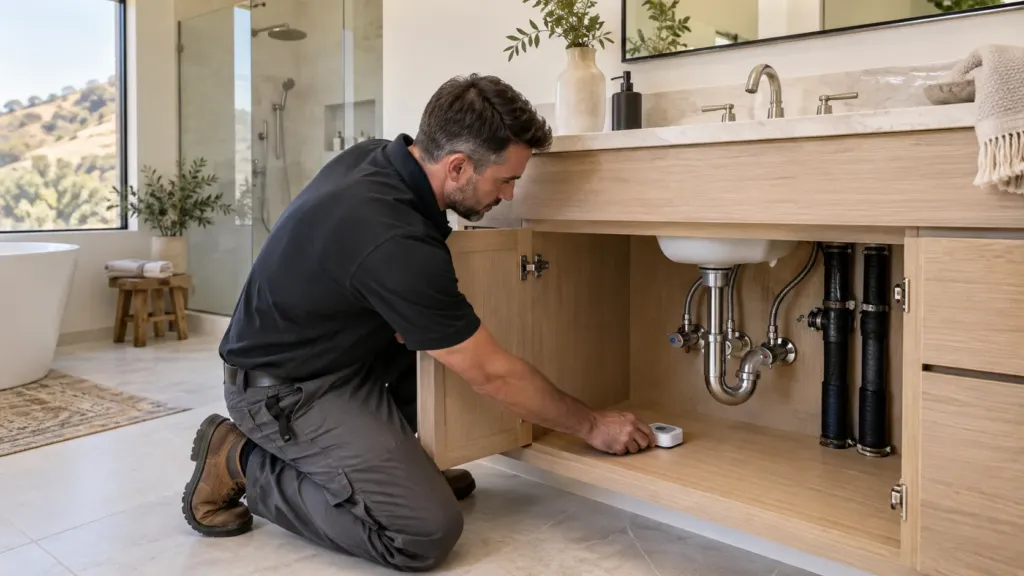
Useful locations include the vanity cabinet, toilet supply, accessible tub connections, nearby mechanical spaces, and any point above a finished room where a leak would be costly. Sensors need contact with escaping water, so placement should follow the likely path across the floor or cabinet base.
The EPA’s leak detection guidance reports that average household leaks can waste more than 9,300 gallons per year and that fixing easily corrected leaks can save homeowners about 10 percent on water bills. EPA also notes that monitoring devices can alert homeowners to irregular water use and help reduce waste and damage.
Decide Whether Alerts or Automatic Shutoff Are Appropriate
A basic sensor sends an audible or phone alert. A whole-home flow monitor may identify unusual usage, while an automatic shutoff can stop the supply when its criteria are met. Each level has different costs, maintenance needs, and risks of false alarms.
Confirm Wi-Fi requirements, battery replacement, valve compatibility, manual override, and what happens during a power outage. Test the system after installation and schedule periodic checks. A device that is offline or sitting in the wrong location provides false reassurance.
7. Correct Excessive Pressure and Add Serviceable Shutoffs
Pressure correction and serviceable shutoffs protect bathroom fixtures as a system. Excessive pressure can increase flow, worsen water hammer, and place unnecessary stress on valves, hoses, and seals.
Test Static and Working Pressure Before Choosing a Solution
Pressure should be measured rather than guessed from how strong the shower feels. A licensed plumber can evaluate static pressure, pressure while fixtures operate, and whether a pressure-reducing valve or expansion-control adjustment is appropriate for the home.
Lowering excessive pressure may reduce unnecessary flow, but pressure that is too low creates poor fixture performance. The goal is a stable, code-compliant range that supports the selected toilet, faucets, shower components, and appliances.
Make Local Shutoffs Easy to Reach and Operate
Replace corroded or inaccessible fixture stops while the vanity and toilet are removed. Quarter-turn valves are often easier to operate in an emergency than old multi-turn designs, subject to the plumber’s product and code recommendations.
For concealed shower components, plan access where practical without compromising waterproofing or aesthetics. Clearly labeled whole-home shutoff access also helps a homeowner or house sitter respond quickly before a small plumbing failure becomes a major repair.
Prioritize the Upgrades by Payback, Access, and Risk
After comparing the seven options, rank them for the specific home. Not every bathroom needs every upgrade, and the most expensive option is not automatically the most valuable.
Start With Low-Cost, Measurable Improvements
Efficient aerators, showerheads, toilet repairs, and leak checks can offer a strong benefit with limited construction. Compare the current fixture flow or flush volume with the proposed product. Check local utility rebates before purchasing because eligible models, dates, and documentation requirements vary.
If the bathroom is not otherwise being remodeled, begin with improvements that do not require opening finished walls. Monitor water bills after installation to see whether usage changes as expected.
Reserve In-Wall Work for the Remodeling Window
Hot-water recirculation, pipe insulation, valve replacement, pressure correction, concealed supports, and access planning are easier to complete while the room is already under construction. Combining them with scheduled work may avoid a second round of demolition and finish repair.
Review the project budget as a system. Kitchen Art Floor and Bath’s guide to how much a bathroom remodel costs explains how fixtures, plumbing changes, surfaces, labor, and contingencies interact.
Preserve Luxury While Reducing Waste
Efficiency should support the design experience, not compete with it. Product selection and detailing determine whether conservation feels intentional.
Test the Experience, Not Just the Specification Sheet
Compare shower spray patterns, faucet reach, toilet height, handle feel, noise, and maintenance access. Showroom testing or verified performance data can reveal more than finish samples alone. An efficient product that frustrates the household may be bypassed, replaced, or used longer than necessary.
A cohesive palette can carry across efficient and conventional products. Matching finishes, carefully proportioned trim, concealed storage, and thoughtful lighting keep practical upgrades from making the room look technical.
Design for Maintenance Without Visual Clutter
Luxury rooms still need service access. Plan removable vanity panels, reachable shutoffs, replaceable cartridges, accessible electrical power for smart devices, and practical routes to concealed equipment.
Avoid Common Water-Saving Upgrade Mistakes
These upgrades can still disappoint when products are selected in isolation or controls are poorly configured. Savings should be designed, installed, and verified.
Do Not Assume Every Efficient Product Fits Every Bathroom
Check plumbing compatibility, pressure, rough-in dimensions, electrical needs, clearances, and local code requirements. A wall-hung toilet, electronic faucet, recirculation pump, or automatic shutoff may require infrastructure that a simple product price does not include.
Avoid adding multiple shower outlets without calculating combined flow. An efficient rain head does not create meaningful savings if several body sprays and a handheld unit operate at the same time.
Do Not Ignore Commissioning and Maintenance
After installation, test for leaks, confirm hot-water delivery, verify temperature limits, demonstrate shutoffs, connect alerts, and record model information. Clean aerators and showerheads as recommended because mineral buildup can distort spray performance.
Replace sensor batteries, exercise shutoff valves, and review unusual water-use alerts. A short handover with the remodeling team helps the household use each upgrade as intended.
Frequently Asked Questions
These concise answers clarify the most common questions about water-saving bathroom upgrades.
Which bathroom upgrade usually saves the most water?
It depends on the existing fixtures and household habits. Replacing a very old toilet or inefficient showerhead can create substantial savings, while repairing a hidden leak may produce the fastest immediate reduction.
Do low-flow showerheads have weak pressure?
Not necessarily. WaterSense-labeled showerheads must meet flow and performance criteria, including spray force and coverage. Household pressure and the selected spray pattern still affect the experience.
Is a faucet aerator worth installing?
Yes, when it fits the faucet and sink. It is a low-cost way to reduce bathroom sink flow without replacing the entire fixture.
Does hot-water recirculation always save money?
No. It can reduce water wasted during the wait, but continuous circulation may increase heat loss and pumping energy. Demand controls, timers, and pipe insulation improve the tradeoff.
Where should a bathroom leak sensor be placed?
Place it where escaping water is likely to collect, such as inside the vanity, near a toilet supply, or below an accessible plumbing connection. Follow the device manufacturer’s placement guidance.
Should water pressure be lowered to save water?
Only when testing shows that pressure is excessive and a qualified professional recommends correction. Pressure that is too low can impair fixture performance.
Can these upgrades be added without a full remodel?
Aerators, showerheads, some toilets, and standalone leak sensors often can. Recirculation, pipe insulation, concealed valves, and major plumbing changes are usually easier during remodeling.
Create a Bathroom That Feels Refined and Operates Intelligently
The practical value of these seven upgrades comes from integration. Efficient fixtures reduce routine consumption, better hot-water delivery reduces waiting, and leak protection helps preserve the finishes the homeowner invested in.
Kitchen Art Floor and Bath has served Orange County homeowners from Laguna Hills since 1988 with a licensed and insured remodeling team. To combine water-conscious plumbing, refined materials, functional storage, and a cohesive luxury design, schedule a bathroom remodeling consultation. The team can review existing conditions and build the right upgrades into the design before construction closes the walls.